What funds can I send to BC Unclaimed?
November 19, 2026
A quick guide to understanding which funds belong with BC Unclaimed — and where other types of unclaimed money should go
Businesses and organizations across British Columbia may find themselves holding money that belongs to someone else. It might be a deposit that should have been returned, an insurance payment, or funds left behind from a court case or after a business closes. Luckily for them, the British Columbia Unclaimed Property Society (BC Unclaimed) exists — a nonprofit organization that stores unclaimed money for BC and safeguards it while proactively searching for owners.
Why submit eligible funds to BC Unclaimed?
Let’s begin with why organizations should send unclaimed funds to BC Unclaimed. For those holding eligible unclaimed property, transferring funds to BC Unclaimed offers several benefits:
It protects consumers: BC Unclaimed maintains a free, searchable public database and proactively searches for rightful owners using resources that are not available to the general public. There is no deadline by which the money must be claimed lest it be forfeited: Funds held by BC Unclaimed remain claimable in perpetuity.
It reduces administrative responsibilities: Transferring eligible funds allows organizations to move on from managing dormant accounts, maintaining records, and responding to future ownership inquiries.
It benefits communities: As a not-for-profit organization, BC Unclaimed also supports charitable initiatives throughout British Columbia through its partnership with Vancouver Foundation, while continuing to safeguard funds for rightful owners.
What types of funds can organizations send to BC Unclaimed?
BC Unclaimed works with organizations to reunite people with money that rightfully belongs to them. Under BC's Unclaimed Property Act and related legislation, certain organizations are required to transfer eligible unclaimed funds to BC Unclaimed, while others can choose to do so voluntarily.
And, while some unclaimed property programs in other provinces may permit all types or different types of funds to be transferred, in BC, eligible types of unclaimed funds include:
Credit union accounts: Dormant chequing and savings accounts held by BC credit unions.
Insurance proceeds: Unclaimed proceeds from life, property, and other insurance policies.
Trust funds: Eligible funds held in benefit, employment, retirement, estate and other trust arrangements.
Real estate deposits: Unclaimed deposits held by real estate agencies or brokerages.
Court funds: Inactive funds held by BC’s provincial courts, Supreme Court and the Court of Appeal.
Estate funds: Certain unclaimed estate funds, including funds administered by the Public Guardian and Trustee.
Business liquidation funds: Undistributed assets remaining after a company or cooperative is liquidated.
Debt collection: Usually, money collected in excess of the amount owed to a creditor.
Municipal tax sales: Surpluses not claimed.
Other eligible funds: Certain government-held deposits, mineral rights proceeds, closed pension plans, securities, and other property as prescribed under provincial legislation.
For a full list of eligible property types, see the website under “property codes”.
When should unclaimed funds go somewhere else?
What happens when your organization holds unclaimed funds that don’t fit one of the eligible types?
In British Columbia, the answer depends on the type of funds, the organization holding them, and the legislation that applies. While BC Unclaimed provides a central place for many types of unclaimed money, some types of unclaimed money are governed by specific legislation or regulations and need to be sent elsewhere. In these cases, organizations must follow the appropriate process under the law when dealing with it.
Some examples are:
Employers: Unpaid wages Employers with unclaimed wages, salaries, or commissions must follow the requirements of BC's Employment Standards Act. These funds can be submitted to the Employment Standards Branch (ESB), which administers them and works to locate former employees who are owed. ESB must transfer funds to BC Unclaimed after one year, should the owner not be located.
Lawyers: Unclaimed trust funds Lawyers holding money in trust for clients they cannot locate must follow the Law Society of British Columbia's trust accounting rules. After making reasonable efforts to locate the rightful owner, a lawyer may apply to remit the money to the Law Society. The Law Society then undertakes its own efforts to locate the owner.
Federally regulated banks: Dormant accounts Dormant bank accounts must be transferred to the Bank of Canada’s Unclaimed Property Program.
Landlords: Security deposits BC Unclaimed cannot accept security deposits due back to a tenant. Please see Residential Tenancy Act or contact the BC Residential Tenancy Branch.
Not sure where your organization's unclaimed funds belong? The first step is to identify the type of funds you are holding and determine which legislation or regulatory requirements apply. If your organization holds eligible unclaimed property, we encourage you to explore the submission process. Staff are available by email and phone to guide you through the submission process.
Contact BC Unclaimed before starting the process if you are unsure whether your organization's unclaimed property qualifies. We're here to help ensure money gets back into the hands of rightful owners, and when that can’t happen, that it is used to help communities across the province through our partnership with Vancouver Foundation.
More from BC Unclaimed

Moving? Prevent losing track of your money in the process
When you move, don't leave money behind: Here's how to avoid your funds becoming unclaimed
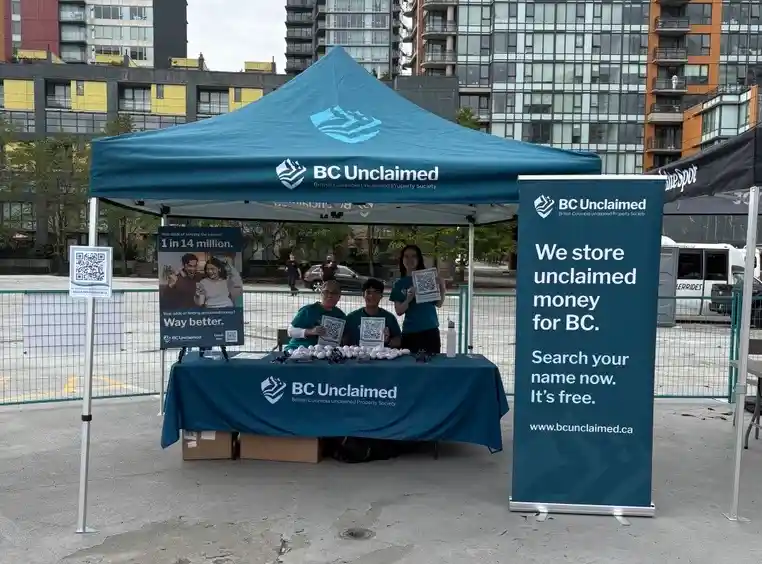
Did you hear us roar with the BC Lions?
What a day we had meeting fans at the tailgate party!

Listen to BC Unclaimed on 103.1 Beach Radio Kelowna
Sherry MacLennan on Kelowna's 103.1 morning radio show